
Blog
New posts coming soon. Subscribe to the newsletter for the first signals.
Let It Happen: a short film about Isadora Duncan, silk dancers and 432 Hz
You don’t have to know the steps. Our second short film is about letting go. 🎧 Best with headphones.
Standing still
Isadora Duncan, the mother of modern dance, wrote that she would stand for hours, perfectly still, her hands folded over her solar plexus. She wasn’t looking for a step. She was waiting for the movement that wanted to come.
Read MoreThe Sand That Sings: a short film about sound, 528 Hz and 1920s dancers
What does sound look like? We made a short film about it. 🎧 Best with headphones.
Singing sand
In 1787, the physicist Ernst Chladni scattered sand on a metal plate and drew a violin bow along its edge. The plate began to sing, and the sand began to move. It gathered on the lines where the plate stood still and formed figures no one had ever seen. Each tone drew its own pattern.
Read MoreThank you — the Viking Edition was unforgettable
Thank you, UniversalSoundShifts and Fralalai, for an unforgettable night of live music and free dance. And thank you to everyone who was there and helped shape the field. 🙏
What you said
What a great combo of good live music and being able to dance freely to it, with all the space. Amazing musicians!
Read More
Vikings Never Wore Horned Helmets. We Do.
Fun fact: Vikings never wore horns on their helmets.
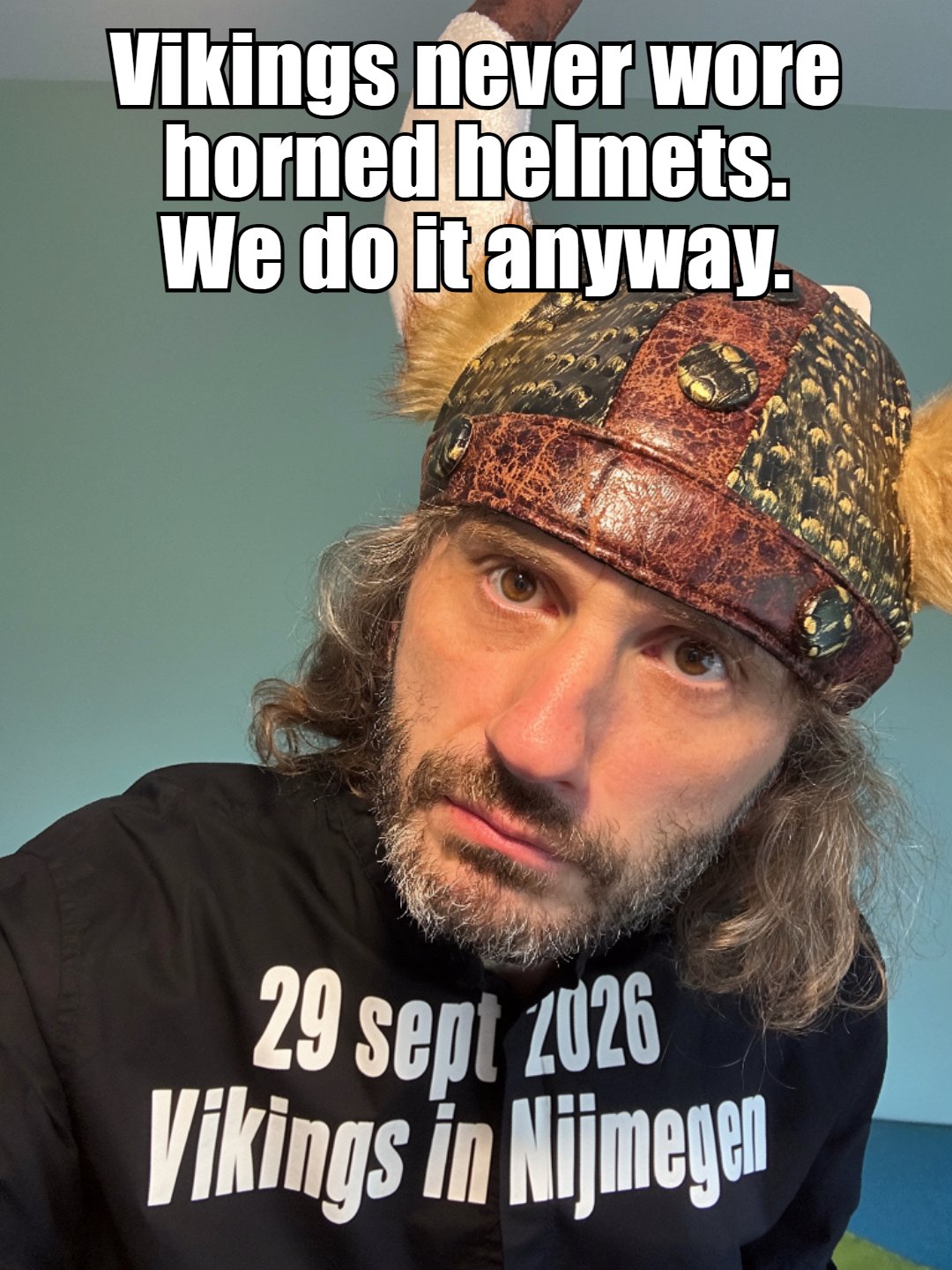
The image of the Viking with a horned helmet is a later invention. It became famous mostly through 19th-century art and the costumes of Wagner’s Ring operas in 1876. The helmets of the real Viking Age were simple and rounded. The best-known find, the Gjermundbu helmet from Norway, has no horns. Much older helmets with horns have been found, such as the Bronze Age helmets from Veksø in Denmark, more than 1,500 years older than the Viking Age.
Read MoreWhy Do We Dance? A Song by Inge and Derk
Sometimes you hear a song that says exactly why you do what you do.
For us, that was the music of Inge (Ivy) and Derk de Geus, from their album Why We Dance. Inge is a well-known face in the Nijmegen dance community, and we love the way she dances. Together with Derk she made a song that asks the question we keep coming back to: why do we dance at all?
Read MoreVIKINGS are coming — Viking Edition in Groesbeek, 29 September
VIKINGS are coming.
On Tuesday 29 September we dance the Viking Edition in Groesbeek.
This is no historical re-enactment. It is an evening where Norse seidr, elemental sound and ecstatic dance meet. No words, no steps. You move the way your body wants to.
Read MoreViking Edition — Where Seidr Meets Ecstatic Dance
September 29 | Groesbeek
Viking Edition.
UniversalSoundShifts — elemental sound weavers invoking wind, breath, and trance journeys.
Fralalai — Celtic harpist singing the old ways back into memory, connecting us to Ancestral Enchantment.
Read MoreTraining the Interpretive Layer: How to See What Was Always There
Training the Interpretive Layer: How to See What Was Always There
After six posts of theory, let’s get practical. How do you actually retrain your brain to perceive differently?
The answer, backed by decades of neuroscience, is simpler than you think – and harder than you want it to be.
Read MoreThe Egregor and Social Reality: When Groups Build Worlds
The Egregor and Social Reality: When Groups Build Worlds
A piece of paper is worth nothing. Unless enough people agree it’s worth $100. Then it can buy food, shelter, and freedom.
Read MoreActive Inference: How Groups Manifest New Realities
Active Inference: How Groups Manifest New Realities
Let’s kill the woo-woo version of manifestation. Not because it’s wrong, but because the real version is so much more powerful.
Neuroscience has identified a mechanism called active inference that explains how brains don’t just passively model the world – they actively reshape it to match their internal predictions. And when groups synchronize this process, the results compound.
Read More